Harkat, Mumbai
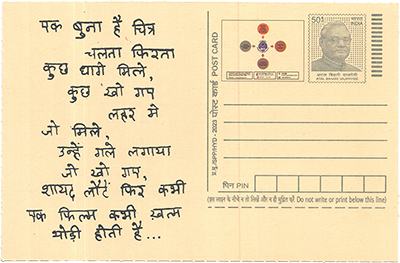
You're here because you got the postcard we sent. This is our 'untitled' film's page of curiosities. Feel free to grab elements and drag them around. Maybe something new reveals itself. Scroll down and read. This will keep evolving as we go. We'll send you an update on substack anyway.


August 7, 2026
Ethos of an indie
What even is an independent film?
In the truest sense, nothing is truly independent in cinema. Film borrows from literature, theatre, photography, music, architecture, painting, design, engineering and performance. It depends on labour, collaboration, collective empathy and generosity. A film is its own thing, but is also an abstract sum. Even the smallest film is held together by the hands of many people. Independence then, cannot simply mean making a film alone or making one without money. It also cannot mean making a film outside of capital markets. In the current world, we cannot divorce ourselves from capital movement and our participation in it.
Maybe independence is better understood as an ethos.
It is an attitude towards making. It is the willingness to learn what is necessary, to build what does not exist, to have the courage to understand everything, and to allow the conditions around you to shape the work.
The mythology of independent cinema often celebrates scarcity. Small crews. Limited budgets. Shoestring productions. While these realities are often true, scarcity by itself does not make a work independent. There are expensive films that possess an independent spirit, and inexpensive films that are deeply dependent on prevailing ideas of what cinema making ought to be like.
How one chooses to make it is the question to ask.
I entered cinema because it was a good home for all that I was interested in. The stories were inroad but I was equally interested in how lenses worked, how photochemistry affected emotion, how light shifted visual interpretation dramatically within seconds, how spaces changed performances, how objects carried memory or how fabrics and materials, both on and off screen, were used to create a moment.
After years of working in commercial cinema, these desires of being independent have all but magnified. Independence is not about dismantling the structures that exist and questioning its ethos as a way of pedestalising oneself, but making one's own value system and quietly sticking to it.
An independent practice, at least for me, has meant refusing to separate thinking from making, material from practice. The camera is not merely a recording device but a sculpture. It’s occupation of the space of cinema has an immense impact of the work. The laboratory is not somewhere the film disappears to after shooting but another site of authorship. Editing is not a technical necessity or a way of assembly but a process of re-thinking. Distribution is not somebody else's problem but part of the work itself.
Every stage becomes part of the creative act.
This is perhaps what the early pioneers of cinema understood instinctively. They were not specialists in the modern sense. They were tinkerers. Chemists. Mechanics. Magicians. Inventors. The same person might design a camera, mix chemistry, project a film and repair the equipment when it broke.
Knowledge was not hierarchical.
Industrial cinema, by necessity, divided these responsibilities into departments. There is enormous value in expertise, but something else was lost in the process. We gradually stopped asking how things worked because someone else knew and it was their job. We borrowed from factory lines and systemised ways of working in industrial complexes. Many senior cinematographers one meets still have no idea how colour film chemistry works.
An independent practice often asks those questions again.
When we began building Harkat, the biggest thing we adopted and learnt was to have our own way of doing things. Even in our commercial work, responsibilities overlap, multiple learnings happen, organic ways of working are prioritised. To an outsider and to a straightjacketed person, this might look like an organisation setup to fail. But for us, its been an intrinsic part of being independent, of being agile and creating a well rounded organisational culture that is able to think more like a tree.
But this also means that learning never stops. You have to keep at it. Sometimes by repeating processes over and over until they become muscle memory. Sometimes by making mistakes only to realise that the mistake was more interesting than the intention. By questioning why things were a certain way. By questioning the purpose and place of everything.
The biggest question of the indie is how the correlation between the process of the maker fits with the paraphernalia around them and how that changes the work. Too often we inherit ideas of filmmaking that were developed under entirely different economic, cultural and technological conditions. We imitate workflows because they are considered professional, not because they are necessary.
And ultimately, the ethos is reflected through how one makes. Can we make a decision to not buy any prop but crowdsource everything? Can one take a decision of only working with natural light or minimal lights? Can a writer double up as a production person? Can a director also be the set electrician? Can we work with a crew of 10? Can we not take that safety shot?
The bigger the beast you make, the slower it moves.
Learning everything feels exhausting. But it’s also liberating.
When I was starting out, I wanted to learn everything because I didn’t want to be dependent on anyone. Now, I do it as a way of process of making. These two kinds of independence are not the same things.
Knowing how to solder a wire may not directly improve a screenplay, but it changes one's confidence around machines. Learning colour science affects how one exposes an image. Understanding chemistry changes how one thinks about light. Building a website changes how one imagines audiences.
Knowledge refuses to stay in its own department. It leaks. That is the real gift of independent practice. It allows unexpected disciplines to sneak into one another in productive ways.
Architecture teaches framing. Music teaches rhythm. Pottery teaches form and patience. Mechanical repair teaches nimble hands. Nature teaches observation.
None of these are filmmaking classes. All of them are cinema.
The ethos of an indie is not heroic self-reliance. It is not romantic poverty. It is not refusing collaboration or rejecting institutions. It is remaining porous. Making unapologetically. Making how your body feels like making. Simply making - on your own.
This manifesto will always be in the making, as it should be.
Karan
Dec 15, 2024
If objects are the ornamentation of space, music is the decoration of time.
The music of a space
When you’re making a film set in a space, it’s perhaps most important to find out what it sounds like. I always feel there is a musicality to every space one enters. Like background music embedded in the walls. But, the cacophony of a *production* sometimes obscures it and doesn’t let you just plainly listen. (yes, lots of lessons learnt in choosing the right size of collaborators and operating in gentler environments) But, blessings come in different forms; or maybe we just make the best of the situation we are in. I’m having to rely on my memory of the house I know so intimately now, the afternoons one has spent just idling there; to bring some truth to the sound of that house. To just listen deeply.
Here are some themes for the film that have evolved. They’re both lovely in some way. They have their strands of truth. And they make me see the eyes of the son in some scenes. A note or two even takes me back to my own childhood.
I would have put a poll here but that feels like a competition between music pieces and art shouldn’t compete with itself. So, if you find muse, reply to the email that came with this and let me know what you think. Or if you fall in love with any piece, send a big heart. All pieces are composed by the wonderful Japji Singh Valecha.
Love, Karan
Love, Karan
पहला अध्याय, पहला आघात
There is so much padding we often do on our own work. To make it seem like something with depth, some more meaning than intended - possibly to generate a little more interest from a few more people. In all this, one often forgets or obscures why we got attracted to this story in the first place. More than often, I’ve found one is just trying to make sense of their own situations for themselves. Or at least, that’s what I am always trying to do. It’s an expensive undertaking. One could also say that going to therapy would be cheaper and maybe even more effective. But, no, we choose to make films.
The source of this film arises from just a few scattered memories. So much so that the working title of the film for very long was ‘kuch bikhri yaadein’. One such memory is of idle summer afternoons in Delhi. There is a peculiar warmth in the air, a fan creaks, the dryness enhances all the smells - of oil in hair, of dusty mattresses, and cheap wooden furniture. My strongest memory is probably just daydreaming while trying to catch swirling dust particles caught between streaks of sun rays. The most poignant holder of memories are objects. Things that remind us of a life lived. And this has possibly been the biggest challenge. Of how to make objects speak, without actually doing a show and tell. Each crack tells a story, each crevice a testament to a time. How is it cinematically translatable. And that’s probably why me and Sheba (co-writer) took years to put together a script that gracefully dealt with objects and our collective memories.
Over the next few weeks, we’ll attempt to get different people attached to the film to share their thoughts and process. The idea is to acknowledge a world of the film outside of the film. Because even films can be very limiting sometimes. What you can expect is insights, poetry, love, life of an indie film and to walk a few steps of the journey with us. Imagine being part of an intimate evening with Harkat peeps. Some of us don’t talk to each other anymore and have scattered, so we will also try to bring them into the fray.
In the coming months, we will bank on your support and comfort as we try to bring the film into the world. The complications of all that are another post altogether. But for now, it's just slowly finishing the film. Writing some lyrics. Finding a title. Coloring it up. And more... It's exciting and I sometimes wish this was a public performance that everyone could witness and be part of. Maybe that's what one is trying to do here.
Love, Karan